
Gartner: Ignoring AEO Could Create Demand 'Blind Spots'

AI is playing a more significant role in the user journey – meaning that marketing leaders need new ways to understand exactly how customer demand is changing.
Research from Advanced Web Ranking has found that, as of March 2026, AI overviews are appearing on 48% of all Google search queries, while a study from Seer Interactive revealed that organic CTR drops 61% when an AI overview is present.
Therefore, organisations that rely on click-based measurement are risking creating “blind spots”, says Gartner – which is particularly damaging as customer behaviour undergoes significant changes.
While marketing leaders have traditionally seen traffic, attribution data and clicks as the key measures of customer demand, Gartner recommends marketers take a hybrid approach to measurement.
Customers now have the ability to receive answers without ever having to visit a company website, creating what Gartner calls “zero-click” experiences – which traditional measurement systems are unable to capture.
This means, Gartner says, that while there may still be a high level of demand for a company's products or services, it’s getting harder for marketers to have visibility into that demand.
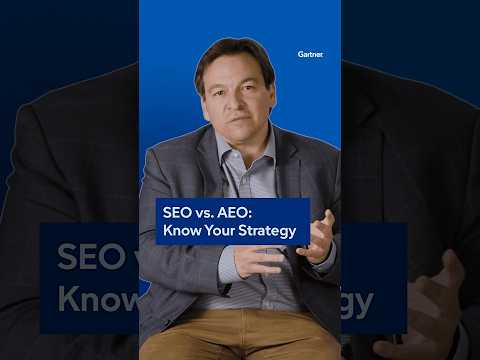
Performance and measurement in an AEO landscape
Traditional measurement systems are revealing less of the customer journey than they once did, according to Joseph Enever, Senior Director Analyst at Gartner.
“Declining organic traffic may reflect a measurement failure, not a performance failure,” he says.
Without adapting measurement approaches, Chief Marketing Officers can risk “misdiagnosing” performance declines, Gartner says, meaning that they can misallocate investment and lose visibility into overall brand influence.
“LLM-mediated customer journeys fundamentally reshape how CMOs need to think about brand health. Brand health is a reflection of being recognised and trusted by customers, as well as by answer engines,” says Joseph.
To understand how brands can best perform in Answer Engine Optimisation (AEO)-enabled environments, Gartner suggests that marketers need better visibility into how AI platforms can represent, reference and recommend their organisation.
The company’s recommendations include incorporating visibility metrics such as:
- Share of answer: Helping a company understand how often it appears in AI-generated responses.
- Citation presence: Which allows marketers to assess if an answer engine references a brand’s content when generating its answers.
- Brand mention frequency and sentiment: So marketers can evaluate how a brand is being portrayed across AI-generated platforms and experiences.
- AEO-influenced conversions: Helping brands better understand how AEO visibility is directly impacting business outcomes.
Declining organic traffic may reflect a measurement failure, not a performance failure."
- As of March 2026, AI overviews are appearing on 48% of all Google search queries.
- The presence of an AI overview causes organic click-through rates to drop by 61%.
- Customers can now receive answers without ever visiting a company website, which is creating what Gartner calls "zero-click" experiences.
- Organisations that rely solely on traditional click-based measurement risk creating blind spots as customer behaviour changes.
- Gartner recommends adopting a "dual-track" measurement model that pairs established business metrics with AI-visibility indicators like share of answer, citation presence and brand mention frequency.
The hybrid future of marketing measurement
However, Gartner stresses that metrics like this cannot replace traditional marketing measures – with the company explaining that the future of marketing measures doesn't involve abandoning established performance metrics.
In fact, traffic, conversions, revenue and customer acquisition cost are still crucial indicators of how a brand is performing – but are increasingly describing outcomes, instead of the full path customers are taking to reach those outcomes.
To properly balance this, Gartner recommends that marketers use a “dual-track” measurement model, to pair established business metrics with AI-visibility indicators.
Brands that can look at both approaches, Gartner says, will be better positioned to understand performance – particularly as customer behaviour continues to evolve.

Who are Gartner’s key clients?
- Microsoft: Through regular engagements with Gartner analysts, Microsoft gained valuable insights and expertise into buyer patterns, market dynamics, and go-to-market strategies tailored to the diverse Asia-Pacific region. In addition to strategic guidance, Gartner took an active role in execution – reviewing plans and documents and delivering analyst-led workshops that influenced Microsoft’s financial year planning and project delivery.
- Wipro: Gartner provided Wipro Enterprises with analyst guidance and valuable insights, enabling them to conduct maturity assessments and map technology options to align with strategic goals and budget constraints, utilise Magic Quadrant and analyst calls to formalise strategic roadmaps and address tactical questions and leverage BuySmart and contract evaluation services to optimise technology procurement and investment strategies.
- AstraZeneca: With more than 100 technical architects across multiple geographies, AstraZeneca faced several challenges around adopting new technologies safely and effectively, while ensuring every investment supports both growth and cyber risk management. The company worked with Gartner to address these complexities facing the organisation using world-class insights and peer networks.
- AWS: Gartner’s AI and GenAI prism analysis helped create a user-friendly tool for customers to view how they could implement AI use cases using AWS products. Their insights accelerated the development of the AI Use Case Explorer, ensuring it meets customer needs across industries and functions.
Company portals





Executives

Joseph Enever
Sr. Research Director, Marketing Data and Analytics