CXO Panellists Discuss the Future of AI in Marketing
According to HubSpot, the marketing industry could be experiencing one of its most significant shifts in a generation.
The company’s 2026 State of Marketing report found that 61% of marketers believe that marketing is experiencing its biggest disruption in 20 years due to – you guessed it – AI.
While the technology can enable marketing teams to do more – with research from Salesforce finding that marketing and sales teams are 1.3 times more likely to achieve revenue growth than those that don’t – getting it wrong can have a negative impact on the trust consumers have with a brand.
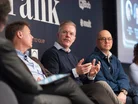
On day one of the CXO Summit, marketing leaders came together to discuss how the marketing industry can implement AI responsibly to accelerate growth, enhance customer experience and improve operational efficiency – while still balancing automation with brand integrity.
The benefits of AI in marketing

AI can make a measurable difference to marketing workflows – with data from McKinsey finding that fully scaling AI-driven marketing strategies can yield an estimated 4% to 7% revenue growth.
“It’s coming at us fast,” says Jasper Martens, Chief Marketing Officer of PensionBee. “But the danger is that many businesses will see AI as a cost-saving opportunity, when actually the opposite can be true.”
Instead, he suggests that, while AI can be a big support in administration, processes and data analysis across the marketing function, treating it as a shortcut can limit its strategic value.
Ashley Gatehouse, Chief Marketing Officer of Accenture Edge, agrees – saying that substantial gains will appear when the technology can create entirely new operational capabilities.
“If you’re just using the technology to make existing processes more efficient, the gains are somewhat limited,” he says. “Where you see dramatic changes is when you’re creating genuinely new capabilities.”
But just because AI can lead to large-scale operational changes in the marketing function doesn’t mean that it can’t make a measurable difference on an administrative level.
“From a marketing perspective, AI is speeding up verification,” says Viola De Girolami, Keynote Speaker and Team Facilitator. “We can sign things off without having to spend an hour going through a contract – meaning that marketers need to ask the question of where else their skills can be valuable.”
- 61% of marketers believe marketing is currently undergoing its largest disruption in 20 years due to AI.
- Marketing and sales teams leveraging AI are 1.3 times more likely to achieve revenue growth compared to non-users.
- Fully scaling AI-driven marketing strategies can generate an estimated 4% to 7% growth in revenue.
- According to Viola, AI-assisted verification can save marketers up to 1 hour of manual review per contract.
- On day one of the CXO Summit, marketing leaders gathered to address implementing AI responsibly to accelerate growth, enhance customer experience and preserve brand integrity.
A human touch
But while AI can have a significant impact on marketing, the panellists agree that people are still crucial for creative thinking and driving results. Bo Hellberg, Chief Marketing Officer of String Furniture, noted that, in his organisation, AI had failed to deliver measurable results.
“I’m not seeing that it has driven any top-line increase,” says Bo. “When trying to build trust, it’s really important that we have a human touch in what we do.”
Bo also shared that relying on AI for content creation can lead to a “middle ground of anaemic copywriting,” rather than creating something inventive and original for an audience.
Other panellists also agreed that preserving customer trust and confidence in a brand requires authentic human input – with Jasper advising against replacing human creative development solely with AI tools, arguing that “the actual creative content has to come from your head”.
But as marketing structures evolve towards environments of both human talent and AI agents, Ashley advises that marketing leaders focus on actively mentoring early-career professionals.
When trying to build trust, it’s really important that we have a human touch in what we do.”
As marketing structures evolve toward hybrid environments of human talent and automated agents, leaders must actively mentor early-career professionals.
“AI is going to fundamentally change the way we work, and it's doing it faster than any revolution we have had,” Ashley says.
“We are going to have human and agentic teams very soon. How are we going to nurture the talent sitting here in 20 years' time?”
Meet the sponsors of the CXO Summit:
- Alexander Group: The Alexander Group is a go-to-market and revenue growth management consulting firm.
- Malt: Malt is Europe's leading freelance management system and online talent marketplace that connects businesses with independent experts.
- HiBob: HiBob is a cloud-based Human Capital Management and HR Information System platform built for mid-sized, fast-growing and global companies.
Company portals






Executives
Ashley Gatehouse
CMO for Avanade and Global Mid-Market Marketing & Communications Lead at Accenture
Bo Hellberg
CMO
Jasper Martens
CMO
Viola De Girolami
Team Facilitator & Change Consultant